Choosing the right generator for your RV comes down to balancing power output, noise levels, and fuel flexibility. While some models prioritize portability for weekend trips, others offer the heavy-duty wattage needed for larger rigs or extended stays. The main differences lie in whether they use gas or dual-fuel systems and how they handle sensitive electronics.
Best overall: Westinghouse 5000 Watt Inverter. This model balances high power with quiet operation and gives you the flexibility of dual-fuel, making it a reliable choice for most RV setups. Best for portability: WEN 4800-Watt Inverter. If weight is your main concern, this unit provides a solid 4000 rated watts while remaining easy to move around the campsite with its built-in wheels. Best for dual fuel: Champion 4000-Watt Inverter. This generator is ideal for those who want the convenience of switching between gasoline and propane right out of the box for longer run times.
This guide is for anyone looking to power their RV with a reliable, safe, and efficient generator.
How We Picked
We compared 30 different generator listings to identify the best options for RV users. To earn a place here, each product had to clearly state its wattage, fuel type, and specific RV-ready outlet configurations. We also prioritized listings that provided transparent safety features, such as CO shutdown sensors and clear noise ratings. Products were excluded if they lacked essential RV connectivity or provided insufficient technical specifications for an informed decision.
All 10 products side by side — scroll sideways to see every column.
| Top Pick | Best for Electronics | Best for Parallel Use | Best for Easy Starts | Best for EV Charging | Best for RV Ports | Best for Extreme Temps | ||||
| Preview | 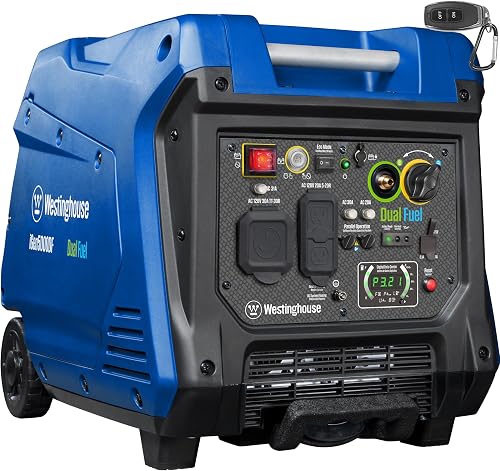 |  |  |  |  |  | 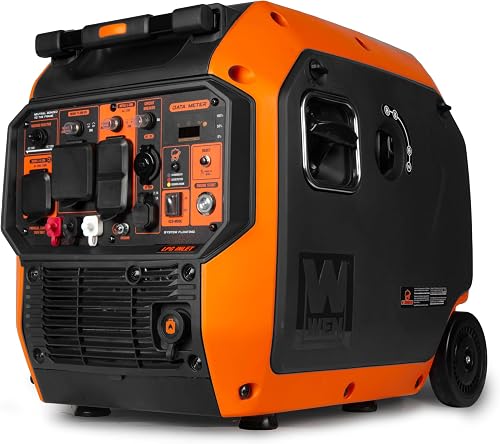 |  | 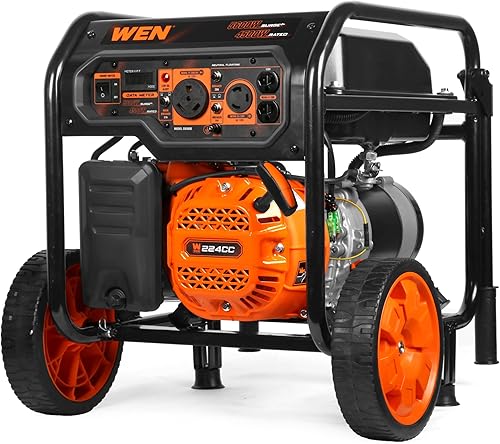 |  |
|---|---|---|---|---|---|---|---|---|---|---|
| Product | Westinghouse 5000 Watt Inverter | WEN 4800-Watt Inverter | Champion 4000-Watt Inverter | WEN 3600-Watt Inverter | Westinghouse 4650 Watt Generator | Champion 4500-Watt Inverter | WEN 6800-Watt Inverter | Power Equipment 4400-Watt Inverter | WEN 5600-Watt Generator | AIVOLT 8000W Dual Fuel |
| Brand | Westinghouse | WEN | Champion Power Equipment | WEN | Westinghouse | Champion Power Equipment | WEN | Oxseryn | WEN | AIVOLT |
| Best for | Best Overall | Best for Electronics | Best for Parallel Use | — | — | Best for Easy Starts | Best for EV Charging | Best for RV Ports | — | Best for Extreme Temps |
| The listing says | 5000 peak watts, 3900 rated watts Gas or propane, remote, electric, recoil start | 224cc engine, 4800 surge, 4000 rated watts Clean power for sensitive electronics | Gas or propane, CO Shield system 4000 starting watts, 3000 running watts | Gas or propane dual-fuel design Clean power for sensitive electronics | 4650 peak, 3600 rated watts gasoline 5-20R, TT-30R, and L5-30R outlets | 4500 starting, 3500 running watts Parallel kit compatible | 224cc dual-fuel engine Bonded-neutral 240V for EV charging | 4400 peak, 3400 running watts Two 120V AC, one 12V DC, one RV port | 5600 starting, 4500 running watts Wheel and handle kit included | 322cc engine, 8000W surge, 6100W running 62 dBA noise, 129lbs weight |
| More information | Check Latest Price on Amazon | Check Latest Price on Amazon | Check Latest Price on Amazon | Check Latest Price on Amazon | Check Latest Price on Amazon | Check Latest Price on Amazon | Check Latest Price on Amazon | Check Latest Price on Amazon | Check Latest Price on Amazon | Check Latest Price on Amazon |
1. Westinghouse 5000 Peak Watt Super Quiet Dual Fuel Portable Inverter
Best for: RV owners needing versatile power and remote starting.
This Westinghouse model offers 5000 peak watts and 3900 rated watts. It features a remote start, which is a significant convenience when you need to power up without leaving your RV. The dual-fuel capability allows you to switch between gas and propane, providing extra run time when you’re off the grid. It’s much quieter than standard open-frame generators, operating at as low as 52 dBA.
If you compare this to the WEN 4800-Watt Inverter, you’ll find that the Westinghouse includes a remote key fob for easier operation. It isn’t the best choice for users who want the lightest possible unit, as its feature set adds to the total weight. Use the “Economy Mode” to maximize fuel efficiency during light loads. If you need to monitor your usage, the LED data center tracks voltage, power output, and remaining run time.
When choosing between fuel sources, remember that gas provides up to 18 hours of run time on a 3.4-gallon tank. If you’re storing the unit for long periods, prioritize propane to avoid fuel degradation. Note that these units are factory-tested, so minor residual oil or fuel odors are normal upon arrival.
Pros
- Remote start with key fob
- Dual fuel gas or propane
- Extremely quiet 52 dBA operation
Cons
- Heavier due to feature set
- Requires manual fuel management
2. WEN Quiet and Lightweight 4800-Watt RV-Ready Portable Inverter Generator
Best for: Campers who prioritize a lightweight, portable design.
The WEN 4800-Watt Inverter is built for those who need to move their power source frequently. It produces clean power, which is essential for protecting sensitive electronics like laptops and tablets inside your RV. The 224cc engine generates 4800 surge watts and 4000 rated watts to handle your campsite needs.
The built-in fuel shutoff is a vital feature that helps extend the engine’s lifespan. By using up the remaining fuel in the carburetor before shutting down, you prevent the gumming issues that often plague stored equipment. If you plan to store the unit for more than a month, always engage this shutoff to save your carburetor.
The WEN Watchdog CO Shutdown Sensor provides an extra layer of safety by automatically killing the engine if carbon monoxide levels become dangerous. While this model is gasoline-only, the inclusion of four 120V receptacles and a dedicated TT-30R RV outlet ensures you have enough ports for most setups. Use this unit if you value portability and safety sensors over the flexibility of dual-fuel systems.
Pros
- Lightweight and portable design
- Includes CO shutdown sensor
- Fuel shutoff extends engine life
Cons
- Gasoline only
- No remote start feature
3. Champion 4000-Watt Dual Fuel RV Ready Portable Inverter Generator
Best for: Users wanting a dual-fuel setup out of the box.
The Champion 4000-Watt Inverter runs on either gasoline or propane immediately. It includes a CO Shield system that triggers an auto-shutoff if it detects dangerous carbon monoxide levels. At 64 dBA measured from 23 feet, the unit operates quietly enough for most campsites.
If you prioritize runtime over raw output, choose propane. It delivers 2700 running watts but lasts up to 25 hours. Gasoline offers 3000 running watts but requires refueling after 10 hours. Don’t attempt to power equipment exceeding these limits, as the inverter provides clean electricity with less than 3% total harmonic distortion.
If you need more power, use the parallel outlets to connect a second unit. You must purchase the parallel kit separately to enable this feature. Every unit includes a 120V 25A TT-30R outlet, a 120V 20A household duplex outlet, and a 12V automotive-style outlet. Champion backs this generator with a 3-year limited warranty and lifetime technical support.
Pros
- Dual fuel versatility
- CO Shield safety system
- Quiet 64 dBA operation
Cons
- Lower running watts than competitors
- Parallel kit sold separately
4. WEN Quiet and Lightweight 3600-Watt Dual Fuel RV-Ready Portable Inverter
Best for: Compact RV setups needing dual-fuel flexibility.
This WEN 3600-Watt Inverter is a compact powerhouse that runs on both gasoline and propane. Its noise levels are comparable to a normal conversation, making it one of the most discreet options for crowded campgrounds. The tool-free LPG connector is a great touch that makes switching fuel types quick and easy.
When placed against the Champion 4500-Watt Inverter, this model is much smaller and easier to pack into tight storage spaces. However, it isn’t for those who need to run multiple high-draw appliances simultaneously due to its lower power output. If your setup requires running a large air conditioner and a microwave at the same time, this 2900-rated-watt unit will likely trip its breaker.
For sensitive electronics like laptops and smartphones, this generator produces clean power to prevent internal damage. The integrated CO Watchdog sensor provides a critical safety layer by automatically shutting down the engine if carbon monoxide levels become dangerous. Use the fuel shut-off feature before long-term storage to prevent carburetor clogs, which is the most common cause of maintenance headaches for portable generators.
5. Westinghouse 4650 Peak Watt Dual Fuel Portable Generator
The Westinghouse 4650 Watt Generator provides a reliable middle ground for those needing portable power without the complexity of an inverter. It balances output between gasoline and propane, offering 3600 rated watts on gas or 3240 rated watts on propane.
Choose this model if your primary goal is running an RV or standard household appliances. If you require ultra-quiet operation for close-quarters camping, look elsewhere; this unit lacks the noise-dampening technology found in inverter generators.
The 4-gallon fuel tank delivers up to 14 hours of run time. Always check the fuel gauge before long trips to avoid mid-night outages. A common mistake is ignoring the residual oil or fuel odor upon arrival; this is normal, as every unit is factory-tested before shipping.
Safety is prioritized through rubber outlet covers and an automatic carbon monoxide shutdown sensor. If the CO sensor triggers, the engine will stop immediately. Ensure the unit is placed in a well-ventilated outdoor area to prevent this.
The package includes oil, a funnel, and a tool kit for immediate setup. With a 3-year limited warranty, this generator offers a sturdy, cast-iron sleeved engine built for long-term reliability.
6. Champion 4500-Watt RV Ready Portable Inverter Generator
Best for: Campers who want reliable, easy-start power.
The Champion 4500-Watt Inverter features an EZ Start Dial that simplifies the startup process significantly. It’s designed to be quiet, operating at 61 dBA, which makes it ideal for tailgating or camping where noise control is a priority. The built-in Intelligauge allows you to monitor voltage, frequency, and operating hours in real time. This ensures you always know the exact load placed on the unit.
If you require more power, use the parallel kit to connect this unit with another 2800-watt or higher Champion inverter. This effectively doubles your output power for larger setups. However, avoid this model if you need to power 240V equipment, as it’s strictly limited to 120V outlets.
While the unit offers 3500 running watts, users often overlook the importance of Economy Mode. Activating this feature monitors power consumption to maximize the 14-hour run time on a single 2.3-gallon tank. Always prioritize the CO Shield auto shutoff system for safety in enclosed RV settings.
Pros
- EZ Start Dial
- Real-time power monitoring
- Quiet 61 dBA operation
Cons
- Parallel kit sold separately
- Gasoline only
7. WEN 6800-Watt Dual Fuel RV-Ready Electric Start Portable Inverter Generator
Best for: High-power needs including electric vehicle charging.
The WEN 6800-Watt Inverter handles demanding equipment and Level 2 charging for electric vehicles through its 240V configuration. The 224cc dual-fuel engine offers flexibility, providing 6800 surge watts on gasoline or 6000 surge watts on propane. If you prioritize long-term storage, use the propane option to avoid gumming up the carburetor.
The fuel shutoff feature is a critical maintenance tool. By burning off remaining fuel before shutdown, you prevent internal buildup that leads to starting issues. Always use this setting if you plan to store the unit for more than a week.
While the unit includes wheels and a telescoping handle for mobility, its size makes it overkill for simple RV setups. If you only need to power lights or a small fan, the extra weight and fuel consumption of this model will be a burden. Stick to smaller, lighter units for basic tasks. If your goal is home backup or vehicle charging, the L14-30R receptacle provides the necessary power. The CO Watchdog sensor adds a vital layer of safety by killing the engine if carbon monoxide levels spike.
8. Power Equipment 4400-Watt Inverter
Best for: Buyers seeking an open-frame inverter design.
This Power Equipment 4400-Watt Inverter is unique because it combines an open-frame design with inverter technology. It’s very lightweight at only 56 lbs, which makes it one of the easiest to transport in this power class. The ECO mode is helpful for saving fuel during low-demand periods, allowing for up to 14 hours of runtime at 25% load.
While it lacks the full enclosure of the Westinghouse 5000 Watt Inverter, it’s much easier to carry. If you need to monitor your supply, the 2-gallon fuel tank includes a gauge for quick checks. It isn’t for people who require the absolute lowest noise levels, as the open frame allows for more sound output. Expect around 72 dBA from 23 feet away.
If you receive your unit and smell gas, don’t assume it’s used. All units undergo factory testing, which leaves a faint scent.
Pros
- Very lightweight
- ECO mode efficiency
- Easy to transport
Cons
- Open-frame design
- Higher noise level
9. WEN 5600-Watt Portable Generator
Best for: Standard, no-nonsense RV power.
The WEN 5600-Watt Generator is a workhorse that gets the job done without extra bells and whistles. It features a 224cc engine capable of 5600 starting watts and 4500 running watts. Its 4.3-gallon tank provides up to 12.5 hours of run time at a half-load, which is enough to cover a full camping trip.
The included wheel and handle kit is a necessary feature that makes moving this heavy unit much easier. If you need to connect directly to a home power system, use the 120V 30-amp NEMA L5-30R twist lock receptacle. For RV owners, the panel provides a dedicated 120V 30-amp TT-30R outlet.
Compared to the WEN 3600-Watt Inverter, this model is strictly for those who need more raw power rather than quiet inverter technology. The listing doesn’t mention a stabilizer. If you prioritize raw output for tools or appliances over noise reduction, this is your unit. If you need to protect delicate computers, look elsewhere.
Pros
- Large fuel tank
- Sturdy wheel kit
- Reliable power output
Cons
- No inverter technology
- No dual-fuel option
10. AIVOLT 8000W Dual Fuel Inverter Generator 50A RV Generator
Best for: Heavy-duty users requiring maximum power.
The AIVOLT 8000W Dual Fuel is designed for those who need serious wattage for large RVs or job sites. Powered by a 322cc 4-stroke OHV engine, it delivers 8,000 surge watts and 6,100 running watts. Despite its size, it’s surprisingly quiet at 62 dBA, and it includes an upgraded lithium battery for reliable starts in temperatures as low as -4°F.
The dual-fuel technology switches seamlessly between gas and propane without manual adjustments. Use Eco-Mode to maximize fuel efficiency, which provides over 10 hours of runtime at 25% load. If you’re storing the unit long-term, the lithium battery ensures it remains ready for emergency backup.
When compared to the Westinghouse 4650 Watt Generator, this unit offers nearly double the power. It isn’t for the casual camper, as its 129-pound weight is significant. If you prioritize portability for light trips, choose a smaller model. If you require high-capacity output for heavy equipment, this is your primary choice.
Pros
- High 8000 surge watts
- Cold-weather start capability
- Dual fuel freedom
Cons
- Very heavy at 129 lbs
- No remote start
How to Choose in Sixty Seconds
Power Requirements
Calculate the total wattage of the appliances you plan to run simultaneously. An RV air conditioner typically requires high starting watts, so check the “surge watts” rating on the generator. Don’t simply rely on the “rated watts” when planning your setup. If you plan to add more appliances later, choose a model that supports parallel connection, such as the Westinghouse or the Champion inverter, which allow you to link two units for increased power. Always check the Environmental Protection Agency guidelines regarding portable generator use, as these units are categorized as non-road engines that require specific maintenance for safe and legal operation.
Fuel Flexibility
Decide if you want the convenience of dual-fuel (gas and propane) or if you prefer the simplicity of gasoline. Propane is often cleaner to store and less prone to gumming up the carburetor during long periods of disuse, making it an excellent choice for seasonal RVers. Gasoline is more widely available at any filling station, which is better for long road trips. If you choose a dual-fuel model, ensure you have a proper storage plan for propane tanks to keep your campsite safe.
Portability and Noise
Consider where you’ll be camping. If you visit crowded campgrounds, a quiet inverter generator is essential to keep noise levels low. If you’re boondocking in remote areas, a larger, more powerful generator might be more practical. Look for models with wheels and telescoping handles if you need to move the unit frequently. Always prioritize generators with CO sensors, as these are critical for safety when running equipment near your living space.
Related guides
- 10 Best Gas for Generator Picks for Reliable Power Performance
- Top 10 Best Solar Generators for Efficient Camping and Emergency Power
Frequently Asked Questions
Do I need an inverter generator for my RV?
An inverter generator is recommended for RV use because it produces clean electricity with low total harmonic distortion. This power protects sensitive electronics like smart TVs and modern RV control boards from damaging spikes. Standard generators may suffice if you only intend to run basic tools or non-electronic appliances.
How do I safely use a dual-fuel generator?
Using a dual-fuel generator requires securing the regulator hose to the propane tank and checking for leaks before starting. Many models feature an easy switch to change between fuel sources. Always operate the unit in a well-ventilated area away from RV openings to prevent carbon monoxide buildup.
Can I run my RV air conditioner with these generators?
Most generators listed here are capable of handling an RV air conditioner. You must match the generator’s surge wattage rating to the high power draw that occurs when the compressor starts. If your air conditioner is particularly large, you may need a higher-wattage unit or a soft-start kit.
How much maintenance does a portable generator require?
Routine maintenance, including oil changes and air filter checks, is key to keeping your generator running for years. Using fuel shutoff features before storage prevents old fuel from clogging the carburetor. Propane-powered models generally require less maintenance because the fuel burns cleaner than gasoline.
Closing
The Westinghouse inverter remains our top pick for its balance of power, quiet operation, and dual-fuel versatility. If you prioritize maximum portability, the WEN 4800-Watt Inverter is an exceptional alternative.
Before finalizing your choice, verify your RV’s specific power requirements. Ensure the unit provides the correct outlets, such as a TT-30R for RVs or 120V household receptacles for your gear. If you plan to charge sensitive electronics like laptops or tablets, confirm the model produces clean power with less than 3% total harmonic distortion.
Safety is a primary requirement. Always prioritize units equipped with automatic carbon monoxide shutdown sensors to protect your family. If you expect to use your generator in freezing temperatures, look for models with low-temperature battery systems, as some standard electric-start units may struggle. Finally, measure your storage space carefully before buying. Check the product page for the latest availability and ensure the unit’s weight fits your transport capabilities, as some models can reach over 100 pounds.